
Chain of Thought & Other Advanced Reasoning Techniques
Explore how advanced techniques like Chain‑of‑Thought prompting and other reasoning methods enable AI systems to break down complex problems step by step - when they work, when they don’t, and how you can use them effectively.
Getting AI to show its work changes everything. Instead of mysterious answers that might be right or wrong, you get transparent reasoning you can actually check. These techniques turn AI from a black box into a thinking partner.
Chain-of-Thought is the most famous technique, but there's a whole toolkit of reasoning methods that make AI dramatically better at complex problems. Let's explore what they are, when to use them, and how to implement them effectively.
Chain-of-Thought: Making AI Think Out Loud
Chain-of-Thought (CoT) prompting asks AI to break down its reasoning step-by-step. Instead of jumping to an answer, it walks through the logic. This simple change improves accuracy on everything from math to creative problem-solving.
The Basic CoT Pattern
Without CoT:
If a store has 48 apples and sells them in bags of 6, how many bags can they make?
AI gives you: 8 bags
With CoT:
If a store has 48 apples and sells them in bags of 6, how many bags can they make? Think through this step-by-step.
AI gives you:
- First, I need to identify what we're solving: dividing total apples by apples per bag
- Total apples: 48
- Apples per bag: 6
- Division: 48 ÷ 6 = 8
- Therefore, they can make 8 bags
The answer's the same, but now you can verify the logic.
When CoT Really Shines
Complex word problems:
Sarah has 3 times as many books as Tom. Tom has 5 more books than Lisa. If Lisa has 12 books, how many books do they have together? Work through this step-by-step.
Multi-part analysis:
Analyze this business proposal step-by-step: First evaluate the market opportunity, then assess the financial projections, then identify potential risks, finally provide your recommendation.
Debugging scenarios:
This code isn't working as expected. Walk through the logic step-by-step to identify where it might be failing: [paste code]
Advanced CoT Techniques
The "Let's work through this" opener:
Let's work through this systematically:[Your question]
This phrase triggers more methodical reasoning.
The structured breakdown:
Solve this problem using these steps:1. Identify what we're looking for2. List what information we have3. Determine the approach4. Execute the calculation5. Verify the answer makes sense. The reasoning checkpoint:[Complex question]. After each step of your reasoning, briefly explain why that step is valid.
This catches logical errors as they happen.
Zero-Shot CoT: The Magic Phrase
Sometimes you don't need to provide examples. Just adding one phrase transforms the reasoning.
The Power Phrase
Just add: "Let's think step by step"
Without the phrase:
A bat and ball cost $1.10 total. The bat costs $1 more than the ball. How much does the ball cost?
Often gets: $0.10 (wrong)
With the phrase:
A bat and ball cost $1.10 total. The bat costs $1 more than the ball. How much does the ball cost? Let's think step by step.
Gets the reasoning process that leads to: $0.05 (correct)
Variations That Work
Different phrasings trigger different thinking styles:
- "Let's approach this systematically" - For procedural problems
- "Let's break this down into parts" - For complex systems
- "Let's consider this carefully" - For nuanced decisions
- "Let's work through the logic" - For deductive reasoning
- "Let's analyze this step-by-step" - For analytical tasks
Zero-Shot CoT Best Practices
Keep it simple: Don't over-explain. The phrase does the work.
Position matters: Put it at the end of your prompt, not the beginning.
Don't mix with examples: If you're showing examples (few-shot), don't use zero-shot phrases. Pick one approach.
Self-Consistency: Let AI Check Itself
Self-consistency means getting multiple reasoning paths and comparing them. If different approaches reach the same answer, it's probably right.
Basic Self-Consistency
Solve this problem three different ways:
A train travels 60 miles in 1.5 hours. What's its average speed?
The AI might:
- Use the formula: Speed = Distance/Time = 60/1.5 = 40 mph
- Convert to minutes: 60 miles in 90 minutes = 2/3 mile per minute × 60 = 40 mph
- Proportion: If 60 miles in 1.5 hours, then 40 miles in 1 hour = 40 mph
Three paths, same answer = high confidence.
Advanced Self-Consistency Patterns
The verification loop:
Calculate the company's profit margin. Then verify your answer by working backwards from the result.
The perspective shift:
Evaluate this decision from three angles: financial, operational, and strategic. See if they align.
The method comparison:
Estimate the project timeline using both bottom-up (task-by-task) and top-down (phase-based) approaches. Compare the results.
Tree of Thoughts: Exploring Multiple Paths
Tree of Thoughts (ToT) has AI consider multiple reasoning branches before choosing the best path. Perfect for problems with multiple valid approaches.
Basic ToT Implementation
Design a mobile app for elderly users. First, brainstorm three different approaches. Then evaluate each approach for pros and cons. Finally, choose the best path forward and explain why.
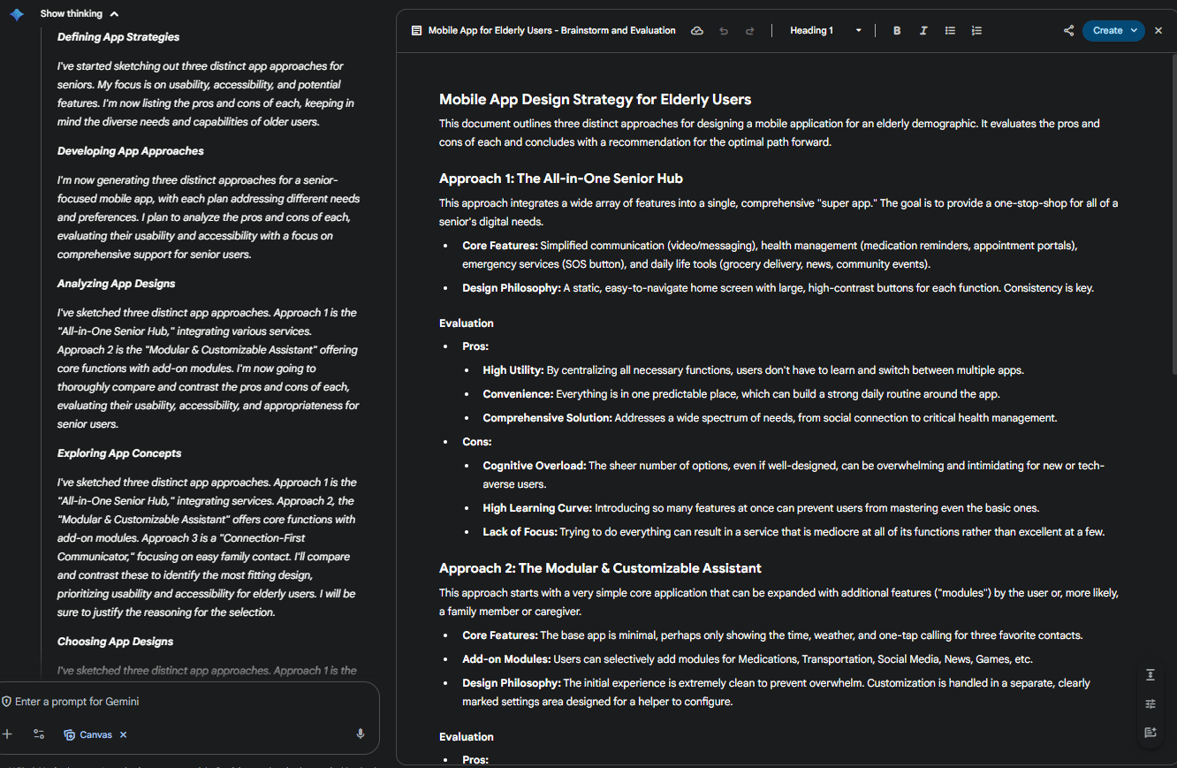
This forces exploration before commitment.
ToT for Problem Solving
The branching strategy:
To reduce customer churn, consider three strategies: Branch 1: Improve customer service Branch 2: Enhance product features Branch 3: Adjust pricing model For each branch, outline:- Implementation steps- Expected impact- Required resourcesThen recommend which branch(es) to pursue.
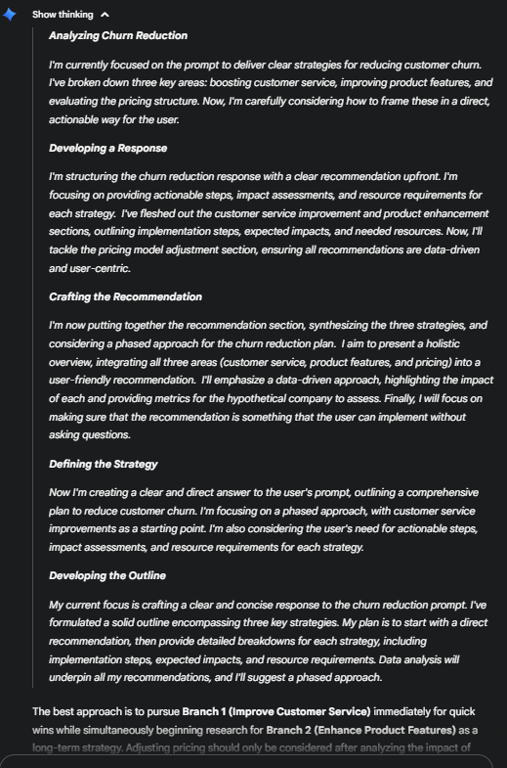
When to Use ToT
- Creative problems with multiple solutions
- Strategic decisions with trade-offs
- Complex troubleshooting scenarios
- Design challenges
- Optimization problems
Least-to-Most: Building Complexity Gradually
Start with simple sub-problems and build up to the complex solution. Like solving a puzzle by doing the edges first.
The Pattern in Action
Instead of:
Create a marketing strategy for launching a new SaaS product
Try:
Let's build a marketing strategy step by step: 1. First, identify the target customer segment 2. Based on that, determine the key value propositions 3. Given the audience and value props, choose appropriate channels 4. For those channels, develop specific tactics 5. Finally, create an integrated timeline and budget
Each step builds on the previous one.
Least-to-Most for Learning
Teaching complex concepts:
Explain machine learning by starting with: 1. What is pattern recognition in everyday life? 2. How do computers identify patterns? 3. What does "learning" mean for a computer? 4. How do we teach computers to improve? 5. Now, putting it together: what is machine learning?
Decomposition Templates
For technical problems:Break this problem into its smallest components, solve each, then combine the solutions.
For analysis:Start by understanding each element individually, then examine how they interact.
For creation:Build the foundation first, then add layers of complexity.
Reflection and Critique: AI as Its Own Editor
Having AI critique and improve its own output often produces better results than getting it right the first time.
The Basic Reflection Pattern
Write a product description for wireless headphones. Now critique your description: What's weak? What's missing? What could be clearer? Based on your critique, write an improved version.
Advanced Reflection Techniques
The assumption check:
Provide a solution to [problem]. Then list all assumptions you made. For each assumption, explain how the solution would change if that assumption were false.
The devil's advocate:
Make a recommendation for [decision]. Now argue against your own recommendation. What are the strongest counterarguments?
The improvement loop:
Draft a response to [task]. Rate it on clarity, completeness, and usefulness (1-10 for each). For any score below 8, revise that aspect.
Structured Critique Framework
After generating your response, evaluate it against these criteria: - Accuracy: Are all facts correct? - Completeness: Is anything important missing? - Clarity: Could anything be explained better? - Practicality: Is this actionable? - Balance: Are different perspectives considered?
Combining Techniques: The Power Stack
The real magic happens when you combine techniques.
Chain-of-Thought + Self-Consistency
Solve this investment problem step-by-step. Then solve it again using a different approach. Compare your answers.
Tree of Thoughts + Reflection
Generate three different solutions to this design challenge. For each solution, identify potential weaknesses. Then create a final solution that addresses those weaknesses.
Least-to-Most + CoT
Break this complex problem into sub-problems. For each sub-problem, think through the solution step-by-step.
The Ultimate Stack
For this strategic decision: 1. Break it down into key components (Least-to-Most) 2. For each component, reason through the implications step-by-step (CoT) 3. Generate three different approaches (Tree of Thoughts) 4. Critique each approach (Reflection) 5. Synthesize the best elements into a final recommendation
Common Reasoning Pitfalls
Over-Complicating Simple Problems
Don't use CoT for 2+2. Save reasoning techniques for problems that actually need them.
Forgetting to Verify
Getting step-by-step reasoning doesn't guarantee correctness. Always check the logic makes sense.
Mixing Too Many Techniques
Start with one technique. Only add others if you need them.
Not Being Specific About the Reasoning Type
Vague: Think about this carefully Better: Walk through the logical steps needed to reach a conclusion
Quick Reference: When to Use What
Chain-of-Thought: Math problems, logic puzzles, multi-step procedures, debugging
Zero-Shot CoT: Quick reasoning when you don't have examples ready
Self-Consistency: High-stakes calculations, verify important answers
Tree of Thoughts: Creative problems, strategic decisions, multiple valid solutions
Least-to-Most: Complex problems, teaching/explaining, building solutions
Reflection: Improving drafts, catching errors, considering blind spots
The Bottom Line
Reasoning techniques transform AI from an answer machine into a thinking partner. The key isn't memorizing every technique - it's knowing when reasoning transparency helps.
Start with basic Chain-of-Thought. Just adding "think step-by-step" improves results dramatically. Once that's comfortable, experiment with other techniques. Self-consistency catches errors. Tree of Thoughts explores options. Reflection improves quality.
The biggest mistake? Not using these techniques when you need them. Any time accuracy matters, transparency helps, or complexity is high, pull out these tools. They take seconds to add to your prompt but save hours of confusion and revision.
Remember: you're not just getting answers anymore. You're getting the thinking behind them. And that changes everything about how useful AI becomes for serious work.
Pick a complex problem you're working on this week. Try solving it with and without Chain-of-Thought. The difference will convince you more than any tutorial could.